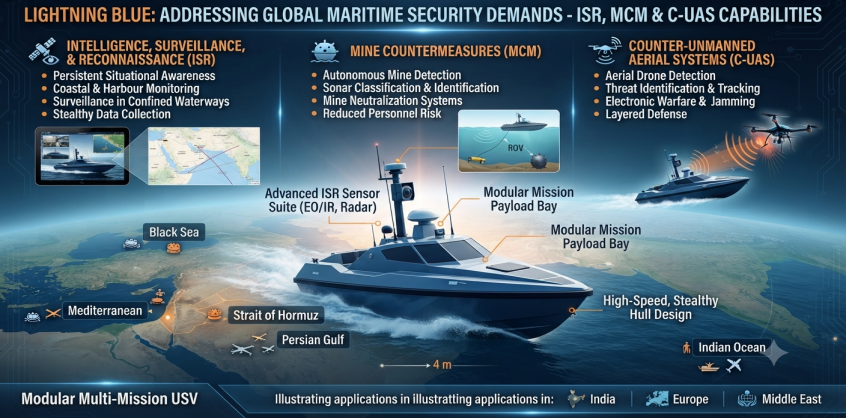
Addressing the Growing Global Demand for Maritime ISR, Mine Countermeasures and Counter-Drone Capabilities
The Changing Maritime Security Environment
The maritime security environment is undergoing a significant transformation. From the Black Sea and Baltic Sea to the Mediterranean, the Persian Gulf and the Indo-Pacific, naval forces are confronting increasingly complex threats from sea mines, unmanned surface vessels, aerial drones, asymmetric warfare and attacks on commercial shipping and critical maritime infrastructure.
Recent developments have demonstrated that conventional naval assets alone may not always provide the flexibility, speed and cost-effectiveness required to respond to these emerging threats.
Unmanned Surface Vessels (USVs), equipped with advanced sensors, surveillance systems and specialised mission equipment, are therefore becoming an important component of modern maritime defence strategies.
Against this background, Lightning Blue, a high-speed, compact and highly manoeuvrable unmanned surface vessel, offers an interesting platform for developing a new generation of maritime security solutions.
Its potential lies not only in its performance as a vessel but also in its ability to accommodate different mission-specific systems, making it adaptable to a wide range of naval, coastal security and maritime surveillance applications.
1. Intelligence, Surveillance and Reconnaissance (ISR)
ISR is a fundamental requirement for every modern armed force. For a country like India, with its extensive coastline, island territories, maritime interests and challenging land borders, persistent situational awareness is particularly important.
Compact and stealth-oriented USVs equipped with advanced surveillance sensors, imaging systems, communication equipment and intelligence-gathering technologies can provide valuable information to the armed forces and security agencies.
Their ability to operate in confined and difficult-to-access waterways gives them an advantage over larger conventional vessels and, in certain operational environments, even aerial surveillance platforms.
Potential operating environments include:
•Coastal waters, harbours and port approaches.
•Rivers, estuaries and narrow maritime channels.
•Inland waterways and waterways passing through forested terrain.
•Sensitive coastal installations and offshore infrastructure.
•Areas requiring persistent surveillance and remote monitoring.
With its high speed, excellent manoeuvrability, good seakeeping characteristics and relatively small radar cross-section, Lightning Blue could offer a versatile ISR platform capable of operating in challenging maritime conditions.
Its ability to operate in adverse weather, subject to the final configuration and operational limits, could further extend surveillance coverage when other assets face deployment constraints.
2. Mine Countermeasure (MCM) Operations
Sea mines continue to represent a serious threat to naval vessels, commercial shipping and critical maritime infrastructure.
Recent developments in the Black Sea have highlighted the dangers posed by drifting mines and the vulnerability of commercial shipping routes. Similar concerns exist in other strategically important maritime regions.
Modern unmanned vessels offer the opportunity to conduct mine detection, classification and other countermeasure operations while reducing the exposure of naval personnel to hazardous environments.
Lightning Blue could be configured to accommodate specialised MCM equipment, including:
•Advanced mine-hunting and detection sonars.
•Towed sonar systems.
•Mine classification and identification equipment.
•Autonomous or remotely operated mine-countermeasure systems.
•Mission control, navigation and communication systems.
The final configuration would depend on the operational requirements and the selection of suitable equipment from specialised technology providers.
Indicative equipment costs illustrate the importance of mission-system selection. For example, the Kraken towed sonar system has been indicated at approximately USD 5 million, while certain Thales sonar solutions may be around USD 10 million. Complete Exail MCM equipment packages have been indicated in the range of USD 8–10 million.
These figures are preliminary reference estimates and are not directly comparable without considering the scope and configuration of each system.
An appropriately equipped Lightning Blue platform could potentially provide a flexible and more cost-effective approach to expanding mine-countermeasure capabilities.
3. Counter-Unmanned Aerial Systems (C-UAS)
The increasing use of low-cost aerial drones in military operations has created a new and urgent requirement for effective counter-drone capabilities.
Recent conflicts have demonstrated how relatively inexpensive drones can threaten naval vessels, ports, offshore facilities and critical infrastructure. Conventional air-defence systems, although essential against certain classes of threats, can be economically unsustainable when used to intercept inexpensive drones.
A modern maritime C-UAS platform could provide a more affordable and flexible layer of defence.
Lightning Blue could potentially accommodate a combination of:
•Radar and electro-optical surveillance systems.
•Drone detection and identification equipment.
•Electronic warfare and jamming systems.
•Appropriate counter-drone effectors.
•Integrated command, control and communication systems.
The actual configuration would depend on the threat environment, required detection range, engagement capability and applicable operational requirements.
The cost of a complete C-UAS solution remains difficult to establish at this stage. Equipment manufacturers generally provide quotations based on specific operational requirements and system configurations.
An initial development and integration programme, potentially supported by DRDO and co-financing from strategic industry partners such as Shish, could help establish the technical configuration, system integration requirements and commercial feasibility.
4. A Growing Global Market and Urgent Operational Requirements
The need for modern maritime security systems is no longer confined to a few major naval powers.
Europe: The Black Sea has witnessed repeated threats to commercial shipping from unmanned systems and sea mines. Romania and Bulgaria face increasing maritime security concerns, while the Baltic region also requires enhanced surveillance and mine-countermeasure capabilities. These developments are creating opportunities for European navies to strengthen their capabilities through unmanned platforms and collaborative procurement.
Eastern Mediterranean: Cyprus, Greece and other countries in the region face evolving threats involving aerial drones, maritime security and protection of critical infrastructure. Greece, in particular, has requirements spanning C-UAS, MCM and ISR capabilities.
Middle East and Persian Gulf: The security environment around the Strait of Hormuz and the wider Persian Gulf remains particularly challenging. The threat spectrum includes sea mines, Iranian-origin drones, unmanned attack vessels and missile systems. Ports, offshore installations, commercial shipping and strategic maritime routes require increasingly sophisticated protection.
Many countries in the region have limited mine-countermeasure capabilities. There is also a growing need to complement expensive conventional air-defence systems with appropriately designed, more affordable counter-drone solutions.
For example, a Patriot PAC-3 interceptor missile can cost approximately USD 5 million. This illustrates the economic challenge of relying exclusively on high-end air-defence interceptors against relatively inexpensive aerial threats.
The combination of maritime surveillance, mine-countermeasure and counter-drone capabilities therefore represents a substantial emerging opportunity for specialised unmanned platforms.
george@aviationspace.in,
maria@aviationspace.in